Tile Adhesive & Grout Calculator — Thinset Plus Grout Takeoff
One takeoff for the whole install. This tile adhesive and grout calculator runs the three passes a job actually needs — tile count, thinset by the trowel you will hold, and grout by the joints you will cut — from one set of inputs, so the shopping list never double-counts its own waste margins. For grout-only depth, the main grout calculator stays open in parallel.
Three-Pass Takeoff
One input set → one shopping list18.6 m²
Pass 1 · Tiles
215
pieces incl. 7.5% cuts
Pass 2 · Thinset
3
× 50 lb bags · 117 lb incl. +10%
Pass 3 · Grout
1
× 25 lb bags · 6.6 kg incl. +10%
Material ratio at a glance — this job
On a standard floor job the adhesive out-weighs the grout roughly 8.0× — if your list says otherwise, a trowel or joint row was mis-picked.
Five trowels, one comparison matrix
Thinset is dosed by the notch, not the bag. The matrix below is the whole adhesive decision: each row is a notch profile with the mortar bed it leaves, the published coverage of a 50 lb bag, and the risk it carries when stretched past its format. Pick the row that matches your tile — the takeoff above auto-selects it.
| Notch profile | Best for | Avg. bed (in) | Coverage (ft² per 50 lb bag) | Consumption (lb/ft²) | vs. baseline | Verdict |
|---|---|---|---|---|---|---|
| 3/16 in V-notch High Risk | Glass & mosaic up to 2 in | 3/32 in | 225 | 0.22 | A V-notch applies roughly half the mortar of a same-size square notch — stretched onto 12 in porcelain it leaves voids, hollow spots and point loads that crack tile. | |
| 1/4 in V-notch | Small format 2 – 6 in | 1/8 in | 180 | 0.28 | The wet-area workhorse: enough ridges to collapse fully under mosaic sheets, still economical at 180 ft² per 50 lb bag. | |
| 1/4 × 1/4 in square Recommended | Standard floor 6 – 12 in | 1/8 in | 95 | 0.53 | ANSI-correct for a 12 in porcelain floor over a flat slab; the ridges collapse and bond 100% of the back. This is the baseline row of the matrix. | |
| 1/4 × 3/8 in square | Plank & large 12 – 24 in | 5/32 in | 75 | 0.67 | For 24 in planks, back-butter in addition to the troweled bed — the published 75 ft² assumes a flat substrate and full ridge collapse. | |
| 1/2 × 1/2 in square | 24 in+ or uneven slab | 3/16 in | 55 | 0.91 | Heaviest consumption on the board at 0.91 lb/ft². If a job needs this notch, the slab is telling you it needs self-leveler, not more mortar. |
Coverage figures are manufacturer-published ranges for polymer-modified thinset over a flat slab; always verify against the bag you buy.
Best-fit scenario
Under ~50 ft² of tile, a premixed adhesive tub beats bagged thinset on total cost — no mixing drill, no half-bag waste. Cross that line and bagged thinset wins: 95 ft² per bag at $0.23/ft² versus premixed at roughly $0.60/ft².
Hidden cost warning
Published thinset coverage assumes a flat slab with 100% ridge collapse. Slabs out of flat by more than 1/4 in per 10 ft burn 20–30% extra mortar — budget the self-leveler, not the extra bags.
Takeoff taboo
Never stretch the 3/16 in V-notch onto 12 in porcelain to "save thinset". Voids under large format become point loads, point loads become cracked tiles — the redo costs 10× the powder you saved.
How to calculate thinset and grout in three passes
Every number the calculator prints comes from one of three formulas. Here they are without the UI, so you can audit any line of the shopping list by hand.
Pass 1 — Tile count
The 1.075 is the 7.5% cutting waste a straight-lay job actually burns; a 50% offset pattern pushes it to 1.10. A 200 ft² floor of 12 × 12 in tile: 200 × 144 × 1.075 ÷ 144 = 215 pieces.
Pass 2 — Thinset
The lb/ft² dose comes from the trowel row — 0.22 to 0.91 depending on notch. Same 200 ft² floor with the 1/4 × 1/4 in notch: 200 × 0.53 × 1.1 = 117 lb, i.e. 3 × 50 lb bags. The 1.1 covers ridge trim-off and pot-life discards.
Pass 3 — Grout
Exact joint geometry at 1.65 kg/L for sanded cement grout. The same floor at 1/8 in joints, 3/8 in depth: 0.185 kg/m² × 18.6 m² = 3.4 kg net → 4.2 kg with margin → one 25 lb bag. The main grout calculator expands this pass with brand tables.
 The notch is the dose: parallel ridges, full collapse, no voidsPhoto: Unsplash
Tile plus grout lines: the layout formulas people skip
A tile calculator with grout has to know where the joints go. Two formulas govern every layout — one along the run, one across the area.
Along a run — tiles length with grout
- A 144 in run of 12 in tile at 1/8 in joints: (144 + 0.125) ÷ 12.125 = 11.88 → 12 tiles, one cut.
- On a 40-tile run, 1/8 in joints add 5 in of floor — the classic under-order.
- Diagonal or herringbone layouts cut twice as many pieces: raise tile waste to 10%.
Across an area — joint line per m²
- 305 mm tile at 3 mm joints: 2000 ÷ 308 = 6.5 m of joint per m².
- That linear figure × joint depth × density is exactly the grout formula in Pass 3.
- Halve the tile size and the joint line doubles — mosaic floors drink grout 4×.
200 ft² porcelain floor — the full takeoff, line by line
This is the floor tile adhesive and grout calculator scenario end to end: a 200 ft² living floor in rectified 12 × 12 in porcelain, 1/8 in joints, 3/8 in tile thickness, slab verified flat to 1/8 in per 10 ft.
Rectified porcelain floor, 200 ft²
12 × 12 in · 1/8 in joints · 3/8 in depth · 1/4 × 1/4 in square notch
Pass 1 · Tiles
215
pieces @ 7.5% cuts
Pass 2 · Thinset
3
× 50 lb bags (117 lb)
Pass 3 · Grout
1
× 25 lb bag (4.2 kg)
Ratio
6.3×
thinset lb vs grout lb
The same floor with three common mistakes
| Mistake | What changes | Real cost |
|---|---|---|
| Ordered tile by room length, ignored joints | Run math off by 5 in on a 40-tile run; last course becomes slivers | +1 box + a visible sliver row |
| Grout depth guessed at 1/4 in, tile is 3/8 in | Joint volume under-read by a third: 2.3 kg vs 3.4 kg | Mid-job grout run-out |
| Slab out of flat, ridges bridge instead of collapse | Thinset consumption climbs from 0.53 toward 0.65 lb/ft² | +1 bag and hollow-sounding floor |
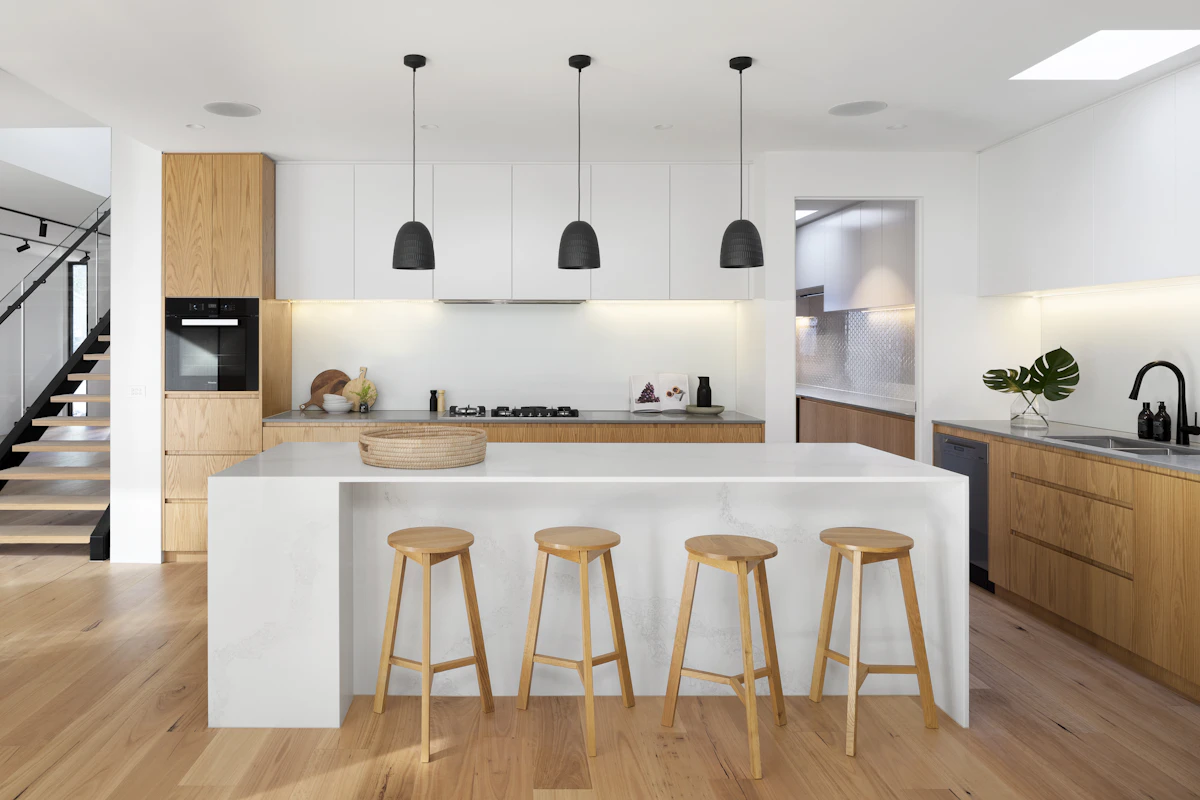 Rectified 12 × 12 porcelain at 1/8 in joints: 95 ft² of bond per thinset bag, 0.185 kg/m² of groutPhoto: Unsplash
When the job grows 10×, the takeoff is not 10× boring
Small jobs forgive lazy math; big jobs amplify it. Three nonlinear effects show up as tile work scales past a few hundred square feet.
1. The premixed-vs-bagged crossover lands near 50 ft²
On a 40 ft² splash, one premixed tub (~$18, 30 ft², zero mixing) beats bagged thinset once you price the drill and the half-bag you will throw away. At 200 ft² the same choice costs $126 in tubs versus $66 in bags — the crossover sits at roughly 50 ft², and every job past it pays the tub premium linearly.
2. Notch creep compounds at scale
Step a 2,000 ft² job from the 1/4 × 1/4 in notch to the 1/2 × 1/2 in notch because the slab is rough, and consumption jumps 0.53 → 0.91 lb/ft²: 1,060 lb → 1,820 lb, 15 extra bags, plus the labor of combing a heavier bed. The correct fix at that threshold is leveling compound (~1.5 lb/ft² per 1/8 in), not mortar.
3. Grout scales super-linearly with format
Joint volume is roughly proportional to 1 ÷ tile size at fixed joint width. Halve the tile format and the grout demand doubles even though the floor area is unchanged — a 2,000 ft² mosaic floor consumes about 4× the grout of the same floor in 12 in tile, which is why the format decision belongs before the grout order.
Adhesive & grout takeoff FAQ
What is a tile adhesive and grout calculator?
A tile adhesive and grout calculator is a materials takeoff that runs three linked passes in one sitting: the tile count for the area, the thinset (adhesive) consumption for the trowel you will actually use, and the grout volume for the joints. A grout-only calculator stops at pass three; an adhesive-only estimator stops at pass two. The reason to run them together is that the passes share geometry — a 12 × 24 in plank at 1/8 in joints consumes 0.67 lb/ft² of thinset through a 1/4 × 3/8 in notch and 0.19 kg/m² of grout at 3/8 in depth, and ordering from three separate calculators is how double-waste margins creep into a shopping list.
How do I calculate thinset and grout for porcelain tile?
Porcelain changes the trowel, not the math. For a porcelain floor, 12 in and smaller over a flat slab takes a 1/4 × 1/4 in square notch — 0.53 lb/ft², so a 50 lb bag covers about 95 ft². Rectified porcelain 12 × 24 in planks step up to a 1/4 × 3/8 in notch (0.67 lb/ft², 75 ft² per bag) plus back-buttering, because ANSI A108 calls for full bed contact on large format. The grout side of porcelain is where rectified edges pay you back: a rectified 12 × 24 at 1/8 in joints holds about 0.15 kg/m² of joint, while a cushioned ceramic of the same face size at 1/4 in joints holds roughly twice that — same calculator, half the grout bags.
How much thinset do I need per square foot?
The honest answer is a table, not a number, because the trowel sets the dose: 0.22 lb/ft² through a 3/16 in V-notch, 0.28 lb/ft² through a 1/4 in V-notch, 0.53 lb/ft² through a 1/4 × 1/4 in square notch, 0.67 lb/ft² through a 1/4 × 3/8 in notch and 0.91 lb/ft² through a 1/2 × 1/2 in notch. Those five rows are the matrix on this page. Multiply your area by the row that matches your trowel, add 10% for ridge trimming and pot-life waste, then divide by the bag weight. A 200 ft² porcelain floor with the 1/4 × 1/4 in notch lands at 200 × 0.53 × 1.1 = 117 lb — three 50 lb bags.
What is a tile calculator with grout?
It is the tile count and the joint count in one tool. The tile row answers how many pieces cover the floor; the grout row answers how much powder the seams between those pieces will drink. They are linked: a 200 ft² floor of 12 × 12 in tile at 1/8 in joints and 3/8 in depth holds about 3.4 kg of grout before margin — one 25 lb bag. Order the tile without the grout line and you make a second trip; order the grout without the tile count and you are guessing from the bag's optimistic coverage chart. This page runs both from the same inputs so the two rows cannot drift apart.
How do I calculate tiles length with grout?
Every run of tiles is longer than N × tile because each joint adds its width: the run length is N × (tile + joint) − joint. Invert it and the tiles a run needs is (run + joint) ÷ (tile + joint), rounded up. A 144 in wall of 12 in tile at 1/8 in joints: (144 + 0.125) ÷ 12.125 = 11.88, so 12 tiles — one of them cut. On a 40-tile run the joints alone add 5 in of floor, which is exactly the number people forget when they order by room length alone. Add the 7.5% cutting waste on top and the order survives a bad diagonal or a cracked piece.
How do I calculate a tile and grout layout before ordering?
Lay it out on paper in three lines. Line one: runs — divide each wall or floor dimension by (tile + joint) to get the tile count per direction, and mark where the cuts fall. Line two: joints — linear joint length per square metre is 2 × 1000 ÷ (side + joint) mm; a 305 mm tile at 3 mm joints runs 6.5 m of joint per m², which is the number the grout pass multiplies by depth. Line three: pattern — a 50% offset doubles the cut count versus a stack bond, so bump tile waste from 7.5% to 10% and re-check the grout row only if the pattern changes joint width. Three lines on paper replace two trips to the supplier.
Should a floor tile adhesive and grout calculator ever use mastic?
Not on a floor. Organic mastic is a premixed adhesive that dries by evaporation — in a thick floor bed it skins over before the tile seats, and it never earns ANSI A118.4 shear strength in wet or heat-exposed zones. On floors, bagged cement thinset is the material the coverage table on this page describes: 0.53 lb/ft² for standard formats and a Working Time you control by mixing. Mastic is legitimate for dry interior walls — a kitchen splash of 4 × 4 in ceramic — where its 30 ft²-per-gallon coverage and zero mixing win. In one sentence: walls can premix, floors must thinset, and a floor tile adhesive and grout calculator that recommends mastic is not a floor calculator.
Should the grout row come from this calculator or the main grout calculator?
Both rows on this page are deliberately consistent with the main grout calculator — same joint-volume formula, same 1.6–1.7 kg/L density band, same round-up-to-package logic. Use this page when the job needs tile count and thinset alongside the grout; use the main grout calculator when grout is the only open question and you want its full brand tables, colour-waste notes and epoxy option. The grout row here links back there on purpose: take the thinset from this page, take the deep grout detail from the main tool, and the two lists will agree because they share the same geometry.
Where the grout row goes deeper
The main grout calculator owns the grout pass — brand tables, colour waste and epoxy. For epoxy kit math, the epoxy grout calculator converts joint volume into kit counts. For surface-specific margins, the wall, floor & shower grout calculator presets the wet-area numbers this page leaves manual.
Related Grout Calculators
Mapei Grout Calculator
Free Mapei grout calculator for Ultracolor Plus FA, Flexcolo...
Laticrete Grout Calculator
Free Laticrete grout calculator for Spectralock PRO, Permaco...
TEC Grout Calculator
Free TEC grout calculator for Power Grout, AccuColor and Ski...
Custom Building Products Grout Calculator
Free custom building products grout calculator for Polyblend...
Bostik Grout Calculator
Free Bostik grout calculator for TruColor premixed urethane,...
ARDEX Grout Calculator
Free ARDEX grout calculator for FL, FG 8, WA epoxy and Endur...
Davco Grout Calculator
Free Davco grout calculator for Elite G10, Davcogrout fine a...
Epoxy Grout Calculator
Free epoxy grout calculator: turn joint volume into 2-part a...
Wall, Floor & Shower Grout Calculator
Free wall floor shower grout calculator with surface presets...
Grout Joint Width Calculator
Free grout joint width calculator: pick the right joint size...
Grout Cost Calculator
Free grout cost calculator: bags × price = material budget. ...
Grout Sealer Calculator
Free grout sealer calculator: convert grout line length into...
Mosaic Tile Grout Calculator
Free mosaic tile grout calculator for penny rounds, 2-inch h...
Grout Calculator UK & Metric
Free UK & metric grout calculator: kg/m² coverage formula wi...
LVT Grout Strip Calculator
Free LVT grout strip calculator: total grout line linear foo...
Patio Grout Calculator
Free patio grout calculator for wide-joint outdoor stone pav...
Trowel Size Calculator
Free trowel size calculator: pick tile format and surface, g...
Mortar Calculator
Free mortar calculator with three modes: thinset by notch co...
Sandbed Shower Pan Calculator
Free sandbed shower pan calculator: 4:1 Portland+sand dry pa...
Sika Grout Calculator
Free Sika grout calculator: SikaTile CEG, Flex and Epoxy til...
Quikrete CMU Grout Calculator
Free Quikrete CMU core fill grout calculator: 6×8×16 through...