Grout Sealer Calculator — How Much Sealer You Need
Sealer is sold in bottles measured in fluid ounces, but your job is measured in linear feet of grout line — and the two are connected by the joint's width and depth. This grout sealer calculator converts tile size and joint geometry into linear feet of line, then into treated joint surface, then into ounces or millilitres of sealer at your product's rated coverage. It also shows the applicator-tip rule of thumb that pros actually buy by, because label ratings and brush-tip reality rarely agree.
Sealer Quantity Planner
Linear feet in → ounces out. Buy the next bottle up.Penetrating band 3,000–12,000 ft²/gal — sprayed tile-and-grout ratings run high; brush-tip reality runs 10–20× richer.
Buy
Grout line
198
linear ft
Treated surface
14.4
ft² of joint
Sealer needed
0.31
fl oz · 9 ml
Rule-of-thumb band
3.3–6.6
fl oz by tip
How the plan ran
- 1. Line length: 100 ft² × 609.7 ÷ 308.0 mm pitch (12" tile + 1/8" joint) = 198 linear ft.
- 2. Joint surface: (1/8" wide + 2 × 3/8" deep) ÷ 12 = 0.073 ft² per linear ft → 14.4 ft².
- 3. Volume: 14.4 ft² ÷ 6,000 ft²/gal × 128 = 0.31 fl oz (9 ml) — label math for penetrating.
- 4. Round up: 0.31 fl oz → 1 × 8 oz bottle. When label math and the tip band disagree, the tip band wins and the next bottle size up settles it.
Independent estimator — not affiliated with any sealer manufacturer. Coverage bands are label-dependent ranges: verify the ft²-per-gallon rating, dilution and recoat interval against the packaging you buy.
Six sealing scenarios, six consumption answers
The calculator above answers "how many ounces". The cards below answer "what actually happens in your room" — because a shower drinks sealer on a different clock than a powder room, and porous stone rewrites the label rating entirely. Tick the filters to highlight the scenarios that match your job.
Shower walls & pan
Line to seal
≈1,130 linear ft
Buy (rule of thumb)
≈19–38 fl oz
A 100 ft² shower of 2 × 2 mosaic at 1/8 in joints holds about 1,130 linear ft of grout line — the densest grid on this page. By the 30–60 linear ft per oz rule, that is roughly 19–38 fl oz of penetrating sealer, and daily wetting compresses the reseal window to 6–12 months. Work the pan slope and the wall corners first: they are the joints that fail first.
Reseal every 6–12 months
Kitchen backsplash
Line to seal
≈233 linear ft
Buy (rule of thumb)
≈4–8 fl oz
40 ft² of 4 × 4 ceramic at 1/8 in joints runs about 233 linear ft of line — 4–8 fl oz by applicator tip. Splash and degreaser wipes are gentler than standing water, so a 12–24 month cycle holds. Wipe sealer off glazed faces within the label's dwell time so the tile, not just the joint, stays haze-free.
Reseal every 12–24 months
Floors, hallways & entries
Line to seal
≈396 linear ft
Buy (rule of thumb)
≈7–13 fl oz
200 ft² of 12 × 12 porcelain at 1/8 in joints is about 396 linear ft of line — 7–13 fl oz by the rule of thumb. Floors reseal on a traffic clock: 12–36 months between coats, with entries and kitchen work zones going bare first. A floor that still beads after a deep clean can wait another season.
Reseal every 12–36 months by traffic
Natural stone & porous cement joints
Line to seal
≈588 linear ft
Buy (rule of thumb)
plan one bottle size up
Porous joints drink sealer: on tumbled stone and soft cement joints, expect the effective ft²-per-gallon rating to drop 30–50% against the label. 150 ft² of 6 × 6 tumbled tile at 1/8 in joints is about 588 linear ft, and a first coat may vanish into the pores before it cures. Plan the next bottle size up — the pint your math suggests becomes a quart. Check your label for stone-specific ratings.
Reseal every 12–24 months, label-dependent
Pools, spas & submerged joints
Line to seal
rating collapses
Buy (rule of thumb)
epoxy grout instead
A penetrating sealer is not a substitute for epoxy grout. Most penetrating labels are rated for splash and wet areas, not permanent immersion, where water pressure and pool chemistry pull the treatment back out of the joint. If the joints are cement and the basin stays full, the reseal window collapses to months. For joints that never need a bottle at all, see the epoxy grout calculator.
→ Epoxy Grout CalculatorReseal every months at best — check your label
Glass mosaic walls
Line to seal
≈678 linear ft
Buy (rule of thumb)
≈11–23 fl oz
Glass does not absorb sealer — the joints do. A 60 ft² accent wall of 2 in glass mosaic at 1/8 in joints is about 678 linear ft of line, so 11–23 fl oz by the rule of thumb. Thin 4 mm glass bodies mean unsanded-friendly joints and shallow depth, so lean toward the higher linear-ft-per-oz end of the band — and wipe the glass faces fast before the residue sets.
Reseal every 12–24 months
Scenario tip
Seal one wall, then time yourself. If an ounce disappears faster than the band predicted, your joints are porous or wider than you measured — re-rate the rest of the job before you open bottle two.
Absorption warning
A first coat on porous cement joints can vanish before it cures. What looks like waste is the pores filling — plan the 30–50% rating haircut on stone before you start, not halfway up the wall.
Sealing don't
Don't flood the joint and let it dry proud of the surface. Sealer that cures on the tile face, not in the joint, is the haze no buyer wants to see — dwell per the label, then wipe.
How to calculate sealer for grout — the linear-foot method
Sealer never sees your room; it sees the joint channel. So the honest calculation runs through linear feet of line, not square feet of floor. Three small formulas — each in plain English — take you from a tile size to a bottle at the counter.
Step 1 — linear feet of line per ft²
One square metre holds 1,000 ÷ (S + g) joint lines in each direction, and two directions make the grid. Convert metres to feet (× 3.2808) and divide by 10.76 to get per-square-foot numbers, and the constant collapses to 609.7. So 12 in tile + 1/8 in joint → about 2.0 linear ft per ft²; 2 in mosaic → about 11.3; 24 in tile → about 1.0.
Step 2 — treated surface per linear ft
A brush tip wets the bottom of the joint and both sidewalls — width plus twice the depth, in inches, divided by 12 to reach square feet. A 1/8 in wide × 3/8 in deep joint is 0.875 ÷ 12 = 0.073 ft² per linear ft. Deeper joints seal slower and drink more; shallow mosaic joints, less.
Step 3 — treated area into ounces
Divide the joint surface your lines make by the product's rated coverage, multiply by 128 ounces per gallon, and you have label-math ounces. One fluid ounce is 29.6 ml for the metric side of the shelf. Then round up to a bottle that exists — 8 oz, pint or quart.
Worked example: 100 ft² of 12 × 12 with 1/8 in × 3/8 in joints
The standard living-room floor geometry — the same inputs the planner above starts with
Grout line
≈198 linear ft
100 × 609.7 ÷ 308 mm
Treated surface
≈14.4 ft²
198 ft × 0.073 ft²/ft
Label math
≈0.31 fl oz
at 6,000 ft²/gal
Buy
1 × 8 oz bottle
tip band: 3.3–6.6 fl oz
On paper, a hundred square feet of floor needs less than half an ounce of penetrating sealer. By the applicator-tip rule of thumb — 30–60 linear ft per oz at 1/8 in joints — the same floor lands at 3.3–6.6 fl oz. Both numbers are "correct"; they answer different questions, and only one of them fits how a brush tip actually dispenses.
Why the label's "up to X ft²" and the brush disagree: printed ratings assume a spray- or roller-metered film across tile and grout, where the joint is a small share of the pass. A brush tip floods each line, wicks deeper on the porous first coat, and over-applies by 10–20×. Hence the 30–60 ft/oz rule — and the standing advice to buy the next bottle size up, because a half-empty bottle keeps, but a half-done wall does not.
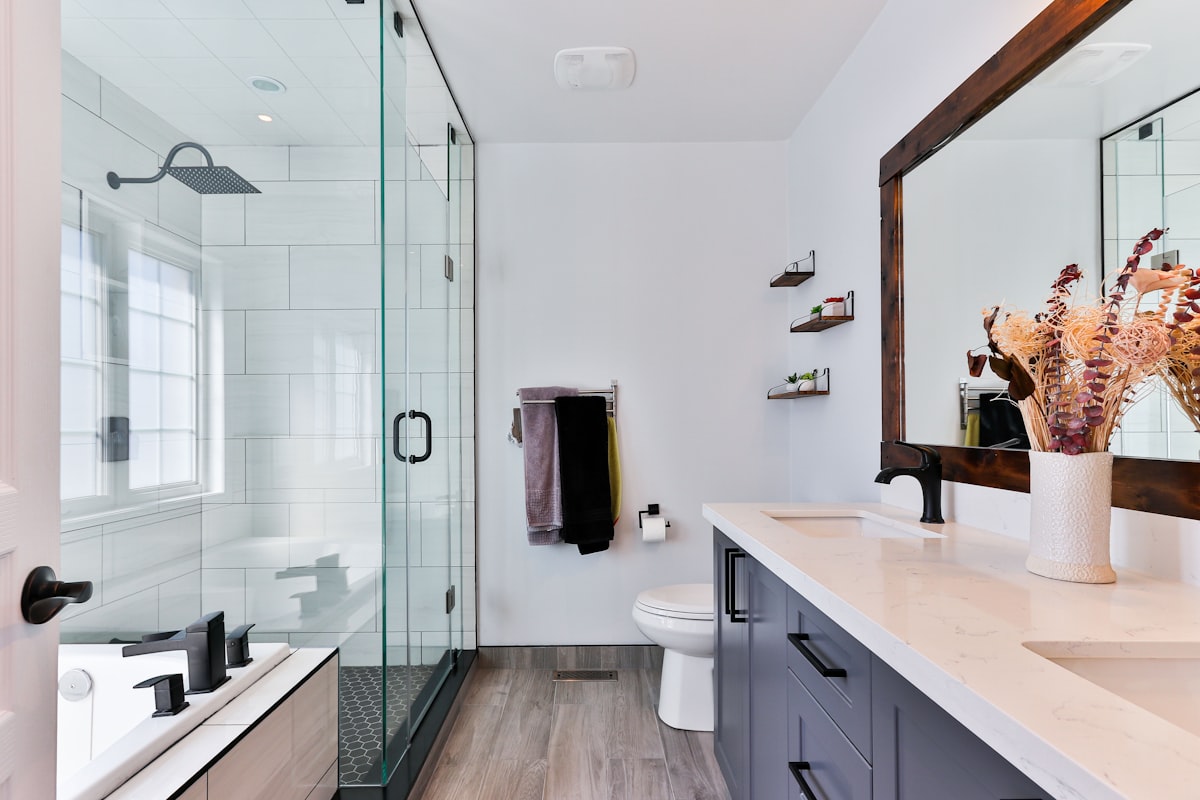 Sealer goes into the joint — the tile face gets wiped, not soakedPhoto: Unsplash
Penetrating vs coating: coverage behaves differently
The two sealer families don't just look different — they consume differently, wear differently and fail differently. A penetrating formula soaks below the surface of the joint, so almost none of it is left on top to scrape; a film-forming coating sits on the joint as a build coat, which is why its printed ratings are 6–8× lower for the same bottle. Run the comparison before you commit a room to either.
| What changes | Penetrating sealer | Film-forming coating | What it means for you |
|---|---|---|---|
| Where it sits | Soaks below the surface into the grout's pores | Dries as a film on top of the joint | Penetrating can't peel or scuff off; a coating can |
| Typical ft²/gal band | ≈3,000–12,000 ft² per gallon — check your label | ≈500–1,500 ft² per gallon — check your label | A penetrating quart goes 6–8× further on paper |
| Oz per 100 linear ft of 1/8 in lines | ≈1.7–3.3 fl oz by applicator tip (label math: 0.1–0.3 oz) | ≈2–4 fl oz by applicator tip (label math: 0.6–1.9 oz) | Coating labels assume a build coat, so label and brush agree better |
| Finish change | None — natural matte look, color unchanged | Adds sheen; can slightly darken light joints | Choose penetrating wherever the look matters |
| Breathability | Breathable — moisture vapor still escapes | Traps vapor under the film | Penetrating is the safer call inside showers |
| Recoat trigger | Water stops beading — 1–3 yr cycles for water-based types | Traffic wears through the film — strip and redo | Penetrating = reapply on top; coating = start over |
The practical read: penetrating sealers win wherever water moves and looks matter — showers, floors, stone — and their 1–3 year water-based cycles are cheap to renew. Coatings earn their keep on decorative walls where sheen is the point, and their strip-and-redo renewal is the price of that look. Neither family makes a poor joint good: sealer protects cement grout from the outside in, but it cannot rebuild a joint that was underfilled in the first place.
Reapplication cycles you can actually schedule
Resealing is not one national date — it is a room-by-room schedule set by how much water and abrasion each surface sees. These are typical cycles for water-based penetrating sealers on cement grout; your product's label may promise more or less, so treat them as planning bands, not promises.
| Location | Reseal cycle | Why the number moves |
|---|---|---|
| Shower walls & pan | 6–12 months | Constant wetting strips protection fastest; squeegee habits and ventilation stretch the cycle |
| Kitchen backsplash | 12–24 months | Splash and degreaser wipes, but no standing water — the middle of the calendar |
| Floors (light residential) | 12–36 months | Abrasion, cleaner chemistry and traffic set the pace; entries go bare first |
| Occasional-use powder room | 24–36 months | Light use and dry air make this the slowest cycle in the house |
The water-bead test
Spray a mist of water on a dry joint. If the water beads and sits on top, the sealer is working. If the grout darkens within 5 minutes, the pores are open again — schedule a reseal. Ten seconds, no lab, no guessing.
Never seal epoxy grout
Epoxy grout is non-porous — there is nothing for a penetrating sealer to soak into, so it pools and dries as a haze you then have to strip. The epoxy grout calculator covers joints that never need a bottle.
Don't seal over problems
Don't seal over efflorescence or uncured grout: the white salt bloom must be brushed off first, or you lock it under the sealer, and fresh joints need their 48–72 h cure per the typical label before any bottle opens.
Buying & aftercare shortcuts
Two shortcuts close the loop. When the bottles are in the cart, the buying & color tips section on our homepage shows how joint width, sanded vs unsanded powder and grout color interact — a mid-tone joint hides the wear that triggers your next reseal, and a properly packed joint holds sealer better than a raked-out one. And if the depth input above had you guessing, the grout calculator computes joint volume and bag counts with the same geometry, so the depth you seal is exactly the depth you grouted. Aftercare is the same story in slow motion: keep pH-neutral cleaner on the shelf, run the water-bead test after every deep clean, and let the calendar — not the bottle's dust — tell you when to reopen it.
Grout sealer FAQ — ounces, cycles and honest labels
How much grout sealer do I need per square foot?
It depends on the tile, because sealer follows the grout line, not the room. A 12 × 12 in floor at 1/8 in joints carries about 2 linear ft of line per square foot, which is roughly 0.14 ft² of treated joint surface. Label math at 6,000 ft²/gal calls for about 0.003 fl oz; applicator-tip reality (30–60 linear ft per oz) runs 0.03–0.07 fl oz per square foot. So a 100 ft² floor is a fraction of an ounce on paper but 3–7 fl oz by brush tip — check your label, then buy the next bottle size up.
How do I calculate sealer for grout lines?
Use the three-step linear-foot method. First, linear feet = area × 609.7 ÷ (tile side + joint width, in mm) — 100 ft² of 12 × 12 tile at 1/8 in joints is about 198 linear ft. Second, treated surface = linear feet × (joint width + 2 × depth) ÷ 12; at 1/8 × 3/8 in joints that is 0.073 ft² per linear ft, so 198 ft treats about 14.4 ft². Third, divide by the product rating and multiply by 128: 14.4 ÷ 6,000 × 128 ≈ 0.3 fl oz. Cross-check against the 30–60 linear ft per oz rule before you buy.
How often should grout be resealed?
Cycles follow the room, not just the calendar. Showers need resealing every 6–12 months because daily wetting strips protection fastest; kitchen backsplashes run 12–24 months; residential floors land anywhere from 12 to 36 months depending on traffic and cleaner chemistry; an occasional-use powder room can stretch to 24–36 months. Don't guess — run the water-bead test: mist a dry joint and watch. Beads that sit on top mean the sealer is working; grout that darkens within 5 minutes is telling you the pores are open again.
Does epoxy grout need sealing?
No. Epoxy grout cures into a dense, non-porous joint, so there are no pores for a penetrating sealer to fill — a sealer simply pools on top and dries as a tacky haze or a patchy sheen. If a product's label claims to 'seal epoxy', it is a topical cleaner-wax hybrid at best, not a penetrating treatment. Cement grout is the porous one that needs the bottle; spend the sealing budget there. Our epoxy grout calculator covers the volume math for the joints that never need sealing.
What coverage should I expect from a quart of sealer?
A quart is 32 fl oz. By applicator-tip reality, a penetrating quart treats roughly 1,000–1,900 linear ft of 1/8 in joints — about 70–140 ft² of actual joint surface. Coatings quote 500–1,500 ft² per gallon, so a quart covers 125–375 ft² of surface on paper, and because coatings are meant to build a film, the label and the brush agree better than they do for penetrating formulas. Either way, these are label-dependent bands, not promises — check your label, match it to your linear footage from the calculator above, and round up.
Penetrating or topical sealer — which lasts longer?
Topical coatings can look freshly sealed longer in dry, low-wear spots because the film itself is the protection, but foot traffic wears the film away, and renewal means stripping and redoing the whole joint. Penetrating sealers fade more quietly — water-based formulas typically run 1–3 year cycles — yet they can't peel, scuff or trap moisture, and they leave the natural matte look. For showers, floors and anywhere water moves, penetrating is the durable choice; for decorative walls where sheen is wanted, a coating is a styling decision, not a longevity upgrade.
Can I seal grout in a shower, and how long does it last?
Yes — shower grout is exactly what penetrating sealer is for. Wait until the grout is fully cured, typically 48–72 hours per the label, and longer before the first hot shower. Work the sealer into every line, wipe the tile within the label's dwell time so nothing hazes the glaze, and let it cure before wetting. In a daily-use shower expect to reseal every 6–12 months; pan joints and corners go first. Watch the bead after each deep clean: mist a wall joint and confirm water still sits on top rather than soaking in within 5 minutes.
Mosaics multiply the line
2 in tile at 1/8 in joints runs about 11.3 linear ft per ft² — roughly 5.7× the 12 × 12 baseline — so the same shower needs 5.7× the sealer per square foot. The mosaic tile grout calculator handles sheet gaps, penny rounds and glass sheets.
The linear-footage sibling
Groutable vinyl plank speaks the same language — linear feet of strip, not bags of powder. The LVT grout strip calculator counts grout lines for plank layouts, and the same footage feeds this page's ounce math. Or start at the homepage grout calculator and work forward.
Related Grout Calculators
Mapei Grout Calculator
Free Mapei grout calculator for Ultracolor Plus FA, Flexcolo...
Laticrete Grout Calculator
Free Laticrete grout calculator for Spectralock PRO, Permaco...
TEC Grout Calculator
Free TEC grout calculator for Power Grout, AccuColor and Ski...
Custom Building Products Grout Calculator
Free custom building products grout calculator for Polyblend...
Bostik Grout Calculator
Free Bostik grout calculator for TruColor premixed urethane,...
ARDEX Grout Calculator
Free ARDEX grout calculator for FL, FG 8, WA epoxy and Endur...
Davco Grout Calculator
Free Davco grout calculator for Elite G10, Davcogrout fine a...
Epoxy Grout Calculator
Free epoxy grout calculator: turn joint volume into 2-part a...
Wall, Floor & Shower Grout Calculator
Free wall floor shower grout calculator with surface presets...
Tile Adhesive & Grout Calculator
One takeoff for the whole install: tile count, thinset bags ...
Grout Joint Width Calculator
Free grout joint width calculator: pick the right joint size...
Grout Cost Calculator
Free grout cost calculator: bags × price = material budget. ...
Mosaic Tile Grout Calculator
Free mosaic tile grout calculator for penny rounds, 2-inch h...
Grout Calculator UK & Metric
Free UK & metric grout calculator: kg/m² coverage formula wi...
LVT Grout Strip Calculator
Free LVT grout strip calculator: total grout line linear foo...
Patio Grout Calculator
Free patio grout calculator for wide-joint outdoor stone pav...
Trowel Size Calculator
Free trowel size calculator: pick tile format and surface, g...
Mortar Calculator
Free mortar calculator with three modes: thinset by notch co...
Sandbed Shower Pan Calculator
Free sandbed shower pan calculator: 4:1 Portland+sand dry pa...
Sika Grout Calculator
Free Sika grout calculator: SikaTile CEG, Flex and Epoxy til...
Quikrete CMU Grout Calculator
Free Quikrete CMU core fill grout calculator: 6×8×16 through...