Epoxy Grout Calculator — Kit Volume Math & Premixed Buckets
Epoxy is not sold in bags — it is sold as liquid volume. So this epoxy grout calculator never converts to powder weight first: it computes the litres of joint your tiles leave open, divides by the published yield of a 2-part or 3-part kit, plans your mixing windows around pot life, and does the same volume arithmetic for resealable pre-mixed pails. The main grout calculator handles bagged cement; this page handles everything that ships as liquid.
Epoxy Kit & Bucket Planner
Volume in → kits out. No powder math.Buy
Joint volume
1.82
L · 0 fl oz
With +10%
2.00
L to place
Mixed weight
—
sold by volume
Chart cross-check
Yield printed on the US data sheet: 0.8 US gal (3.0 L) per Full unit
Parts inside the package
2-part: A 18.1 fl oz + B 18.6 fl oz + C 9.0 lb powder
Kit yields are printed volumes — no chart cross-check needed; the math divides by the yield directly.
Independent estimator — not affiliated with LATICRETE, MAPEI or Custom Building Products. Kit yields and chart rows are quoted from published data sheets; verify against the packaging you buy.
Six epoxy jobs, six packaging answers
The calculator above answers "how much". The cards below answer "which package" — because a kit that fits a backsplash can be wrong for a pool, and a pail that breezes through a bathroom floor is banned in a steam room. Tick the filters to highlight the scenarios that match your job.
Kitchen backsplash refresh
Area band
12 – 30 ft²
Buy
2 Mini kits
A 30 ft² splash of 4 × 4 in tile at 1/8 in joints and 1/4 in depth holds 1.06 L of joint — two Mini units cover it with the 10% margin intact.
⏱ 2 mixing windows (80 min each)
Shower walls + pan
Area band
90 – 120 ft²
Buy
1 Full kit
100 ft² of 6 × 6 in wall tile at 1/8 × 1/4 in joints is 2.38 L of joint; add the wet-area margin and one 3.0 L Full unit finishes it inside a single window.
⏱ 1 mixing window (80 min)
Porcelain kitchen floor
Area band
180 – 250 ft²
Buy
1 Commercial unit
200 ft² of 12 × 24 in plank at 1/8 × 3/8 in needs about 2.7 L. The Commercial box is four separate Full kits — mix one, place it, mix the next.
⏱ 2 mixing windows
Pool or spa (submerged)
Area band
any size
Buy
kits by volume math
Submerged use is where the packaging rule hardens: epoxy kits are rated for permanent immersion, and every pre-mixed pail on this page is not. Water chemistry eats acryllic binders.
⏱ windows of 80 min
DIY weekend bathroom
Area band
40 – 80 ft²
Buy
1 gallon pail
A 1 gal pail holds 3.785 L; 60 ft² of 8 × 8 in tile at 1/8 × 3/8 in consumes about 1.6 L. Stop whenever you like, snap the lid, continue tomorrow.
⏱ Unlimited — reseal and resume
Steam room / hot zone
Area band
40 – 100 ft²
Buy
kits by volume math
Pre-mixed grouts carry their own temperature ceilings (Flexcolor CQ: not above 125 °F; steam rooms excluded outright). A true RG epoxy kit is the only card that survives the room.
⏱ windows of 80 min
Scenario tip
Two kits mixed back-to-back beat one giant batch every time: the second window starts fresh while the first is on the wall, and no kit dies in the bucket.
Temperature warning
Pot life is a temperature number. An 80-minute window at 21 °C shrinks toward 40 minutes on a hot slab — plan summer pours in smaller kits, not bigger ones.
Packaging don't
Don't split a kit to "save the rest". Parts A and B are pre-dosed — half a kit is half a chemical reaction that never finishes curing.
How to calculate epoxy grout quantity: the formula, in plain numbers
The epoxy grout calculation formula is one line: joint volume = depth × open channel area. Everything else — kits, buckets, batches, weights — is division. Here is the chain for how to calculate epoxy grout quantity without a spreadsheet.
Step 1 — litres of joint per square foot
s = tile side, g = joint width, d = tile thickness, all in millimetres. For 12 × 12 × 3/8 in tile at 1/8 in joints: d = 9.5, s = 305, g = 3.2 → 0.0185 L/ft². A 100 ft² job holds 1.85 L. A mosaic shower with 2 × 2 in tiles holds 3.6× more at the same joints — which is why mosaics eat kits.
Step 2 — litres into packages
The 10% covers clean-up loss and the epoxy that sets in the bucket when a phone call runs long. Divide by 3.785 for gallons — the pre-mixed pail is just a kit with no pot life. Round up: nobody sells 0.4 of a Full unit.
Worked example: 100 ft² bathroom floor in SPECTRALOCK PRO
12 × 12 × 3/8 in porcelain, 1/8 in joints — the anchor geometry
Joint volume
1.85 L
100 ft² × 0.0185
With +10%
2.03 L
≈ 69 fl oz
Kit yield
3.0 L
A 18.1 fl oz + B 18.6 fl oz + C 9 lb
Buy
1 Full unit
one 80-minute window, done
Swap the same floor to 2 × 2 in mosaic and the joint volume jumps to 6.7 L — three Full units, or one Commercial box worked two windows at a time. Same area, 3.6× the epoxy: the tile size line of this formula is where epoxy budgets are won or lost.
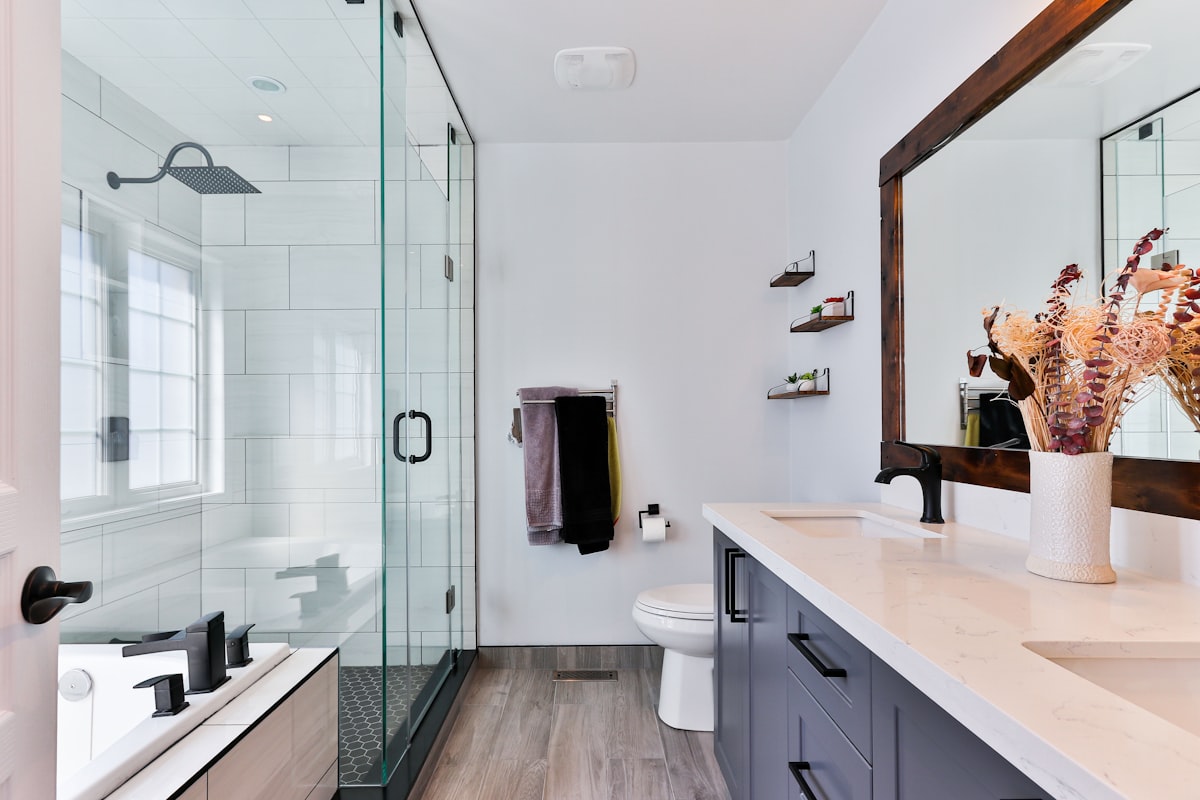 Liquid in, liquid placed — epoxy never loses water, so the litres you compute are the litres you seePhoto: Unsplash
How much pre-mixed grout do I need? The bucket math, verified
Learning how to calculate pre-mixed tile grout for spaces is the same volume exercise with friendlier packaging: the pail is resealable, the pot life is infinite, and the printed charts prove the arithmetic. Here is how to calculate pre-mixed tile grout quantities against the two most common US pails.
| Tile (W × L × thickness) | 1/16" | 1/8" | 1/4" | 3/8" | 1/2" |
|---|---|---|---|---|---|
| 2 × 2 × 1/4 in | 103 | 55 | 31 | 23 | 19 |
| 6 × 6 × 1/4 in | 298 | 152 | 79 | 55 | 43 |
| 12 × 12 × 3/8 in | 393 | 199 | 101 | 69 | 53 |
| 18 × 18 × 3/8 in | 588 | 296 | 150 | 101 | 77 |
| 24 × 24 × 3/8 in | 782 | 393 | 199 | 134 | 101 |
Source
SimpleGrout (Custom Building Products)
Square feet per 1-gallon pail, transcribed from the published chart. The planner above reproduces the 199 ft² anchor within 3% using pure volume math — no fudge factor required.
Cross-check
Flexcolor CQ (MAPEI)
At 6 × 6 × 1/4 in with 1/8 in joints MAPEI prints 155 ft²/gal; the volume formula computes 151 ft². Two manufacturers, one arithmetic — liquid coverage is pail litres ÷ joint litres.
Density bridge
SPECTRALOCK 1 (LATICRETE)
The 1 gal pail weighs 14.2 lb — 1.69 kg/L, right in the true-epoxy density band. That single line lets any bucket math convert to weight when a scale, not a pail, is what the counter sells you.
Epoxy grout FAQ — volume in, kits out
How do I calculate epoxy grout quantity?
Epoxy is sold as liquid volume, so the calculation is volume against volume. First compute the joint volume: depth × (2 × tile side × joint width + joint width²) ÷ (tile side + joint width)², all in millimetres, gives litres per square metre — divide by 10.76 for litres per square foot. Multiply by your area, add about 10% for waste and clean-up, then divide by the kit's mixed yield. A SPECTRALOCK PRO Full unit yields 3.0 L, a Mini 0.7 L, a Commercial box 12.0 L, and a 9 lb Kerapoxy CQ kit about 2.4 L. One example: 100 ft² of 12 × 12 × 3/8 in tile at 1/8 in joints holds 1.87 L; with 10% waste that is 2.06 L — one Full kit (3.0 L) or one Kerapoxy kit (2.4 L) covers it.
What is the epoxy grout calculation formula?
The formula behind every epoxy tile grout calculator: joint volume (L) = area (m²) × depth (mm) × (2 × side (mm) × joint (mm) + joint²) ÷ (side + joint)². For a square tile this is exactly the open channel area between four tiles, times the joint depth. Kits then divide out: kits = joint volume × 1.1 ÷ kit yield. Pre-mixed pails use the same formula with the pail's litres instead of a kit's — 1 US gallon is 3.785 L. What you never do with epoxy is compute bag weight from a cement density: there is no dry powder to weigh, and the mixed material has no water to lose.
How much pre-mixed grout do I need?
Divide your joint volume by the pail's liquid volume. A 1 gallon pail holds 3.785 L, and the printed coverage charts agree: Custom Building Products' SimpleGrout table lists 199 ft² per gallon at 12 × 12 × 3/8 in tile with 1/8 in joints — the pure volume math gives 204 ft², within 3%. Mapei's Flexcolor CQ lists 155 ft² per gallon at 6 × 6 × 1/4 in with 1/8 in joints, which the same arithmetic reproduces at 151 ft². So for pre-mixed, the answer is simply: area × litres-per-ft² ÷ 3.785, rounded up to whole pails.
How do I calculate pre-mixed tile grout for different spaces?
Work space by space, because joint geometry changes per surface. Measure each space's area, pick the tile size, joint width and tile thickness for that space, compute its litres of joint (the formula above), sum the spaces, then divide by 3.785 L per gallon and round up. A typical bathroom: 60 ft² floor of 12 × 12 × 3/8 at 1/8 in = 1.11 L; 90 ft² walls of 8 × 8 × 3/8 at 1/8 in = 2.43 L; 30 ft² shower floor mosaic of 2 × 2 × 1/4 at 1/8 in = 2.02 L. Total ≈ 5.6 L → two 1 gallon pails with margin — which is exactly why resealable pre-mixed packaging is forgiving for multi-space jobs.
How does pot life affect how many kits I buy?
Pot life decides batching, not quantity — but it changes how you buy. SPECTRALOCK PRO gives 80 minutes of working time at 21 °C per mix; Kerapoxy CQ about 45 minutes at 73 °F. You cannot mix three Full units in one bucket and place them all: the third would be setting while the first is still on the wall. So the planner counts mixing windows — one kit per window for Minis and Fulls, and the Commercial 12 L box is deliberately four separate Full doses for exactly this reason. If your schedule only allows two windows, buy the packaging that fits two windows, not more material than you can place.
Does epoxy coverage differ from cement grout coverage?
The joint volume is identical — geometry does not care about chemistry. What changes is the conversion. Cement grout is sold as dry powder: litres of joint × ~1.6 kg/L of mixed grout, adjusted for the water you add. Epoxy is sold as liquid volume: litres of joint ÷ litres per kit or pail, full stop. Epoxy also loses nothing to evaporation, so the volume you compute is the volume you place, while a cement joint slurry shrinks slightly as it cures. That is why epoxy coverage charts read a touch more generous than cement tables for the same tile.
What is the difference between 2-part and 3-part epoxy kits?
A 2-part kit pairs liquid resin and hardener with a coloured powder (Part C) that fills volume and carries the pigment — SPECTRALOCK PRO's Full unit is A 18.1 fl oz + B 18.6 fl oz + 9 lb of powder, mixing to 3.0 L. A 3-part kit like Davco's or Kerapoxy CQ splits resin, hardener and filler into three containers but works the same way. The part count is packaging, not math: both resolve to one number, the mixed litres printed as yield. For coverage purposes a 9 lb kit and a 2.4 L yield describe the same bucket of mixed epoxy.
Is pre-mixed grout the same as epoxy grout?
Not always — and the distinction matters for where you can use it. True epoxy grouts are reactive 2-part systems that cure chemically and are rated for submerged use in pools. Some pre-mixed pails, like SPECTRALOCK 1 Translucent, are engineered to meet ANSI A118.3 — the epoxy performance standard — in a resealable single-component pail, and LATICRETE lists it as submersible after 14 days. But most pre-mixed grouts (SimpleGrout, Flexcolor CQ, Easy Grout-style products) are acrylic-based: excellent for showers, splashbacks and interior floors, but explicitly not for submerged areas, steam rooms or continuous heat. Check the rating on the pail, not the word 'pre-mixed' on the shelf.
Bagged cement side of the aisle
For powder grouts sold by the bag — cement, sanded or unsanded — the main grout calculator converts joint volume to dry weight, with brand-specific pages for ARDEX and Davco.
Surface presets for epoxy jobs
Showers, floors and walls change the joint geometry more than the chemistry does. The wall, floor & shower grout calculator carries the per-surface presets this page assumes.
Related Grout Calculators
Mapei Grout Calculator
Free Mapei grout calculator for Ultracolor Plus FA, Flexcolo...
Laticrete Grout Calculator
Free Laticrete grout calculator for Spectralock PRO, Permaco...
TEC Grout Calculator
Free TEC grout calculator for Power Grout, AccuColor and Ski...
Custom Building Products Grout Calculator
Free custom building products grout calculator for Polyblend...
Bostik Grout Calculator
Free Bostik grout calculator for TruColor premixed urethane,...
ARDEX Grout Calculator
Free ARDEX grout calculator for FL, FG 8, WA epoxy and Endur...
Davco Grout Calculator
Free Davco grout calculator for Elite G10, Davcogrout fine a...
Wall, Floor & Shower Grout Calculator
Free wall floor shower grout calculator with surface presets...
Tile Adhesive & Grout Calculator
One takeoff for the whole install: tile count, thinset bags ...
Grout Joint Width Calculator
Free grout joint width calculator: pick the right joint size...
Grout Cost Calculator
Free grout cost calculator: bags × price = material budget. ...
Grout Sealer Calculator
Free grout sealer calculator: convert grout line length into...
Mosaic Tile Grout Calculator
Free mosaic tile grout calculator for penny rounds, 2-inch h...
Grout Calculator UK & Metric
Free UK & metric grout calculator: kg/m² coverage formula wi...
LVT Grout Strip Calculator
Free LVT grout strip calculator: total grout line linear foo...
Patio Grout Calculator
Free patio grout calculator for wide-joint outdoor stone pav...
Trowel Size Calculator
Free trowel size calculator: pick tile format and surface, g...
Mortar Calculator
Free mortar calculator with three modes: thinset by notch co...
Sandbed Shower Pan Calculator
Free sandbed shower pan calculator: 4:1 Portland+sand dry pa...
Sika Grout Calculator
Free Sika grout calculator: SikaTile CEG, Flex and Epoxy til...
Quikrete CMU Grout Calculator
Free Quikrete CMU core fill grout calculator: 6×8×16 through...